
What’s Happening With Maui Kamaole? Where the Complex Stands in Maui’s Condo Rezoning Process
 If you own at Maui Kamaole, are considering purchasing there, or are thinking about selling, you may be wondering where the complex stands in Maui County’s rapidly changing short-term vacation rental and hotel-zoning process.
It’s a good question, especially because several nearby South Maui condominium complexes are already moving through potential rezoning pathways.
As of now, Maui Kamaole is not included in the current resolutions moving selected properties toward H-3 or H-4 Hotel District zoning.
But that does not mean Maui Kamaole has been overlooked entirely, nor does it mean the County has made a final determination about the property.
Maui Kamaole’s Current Status
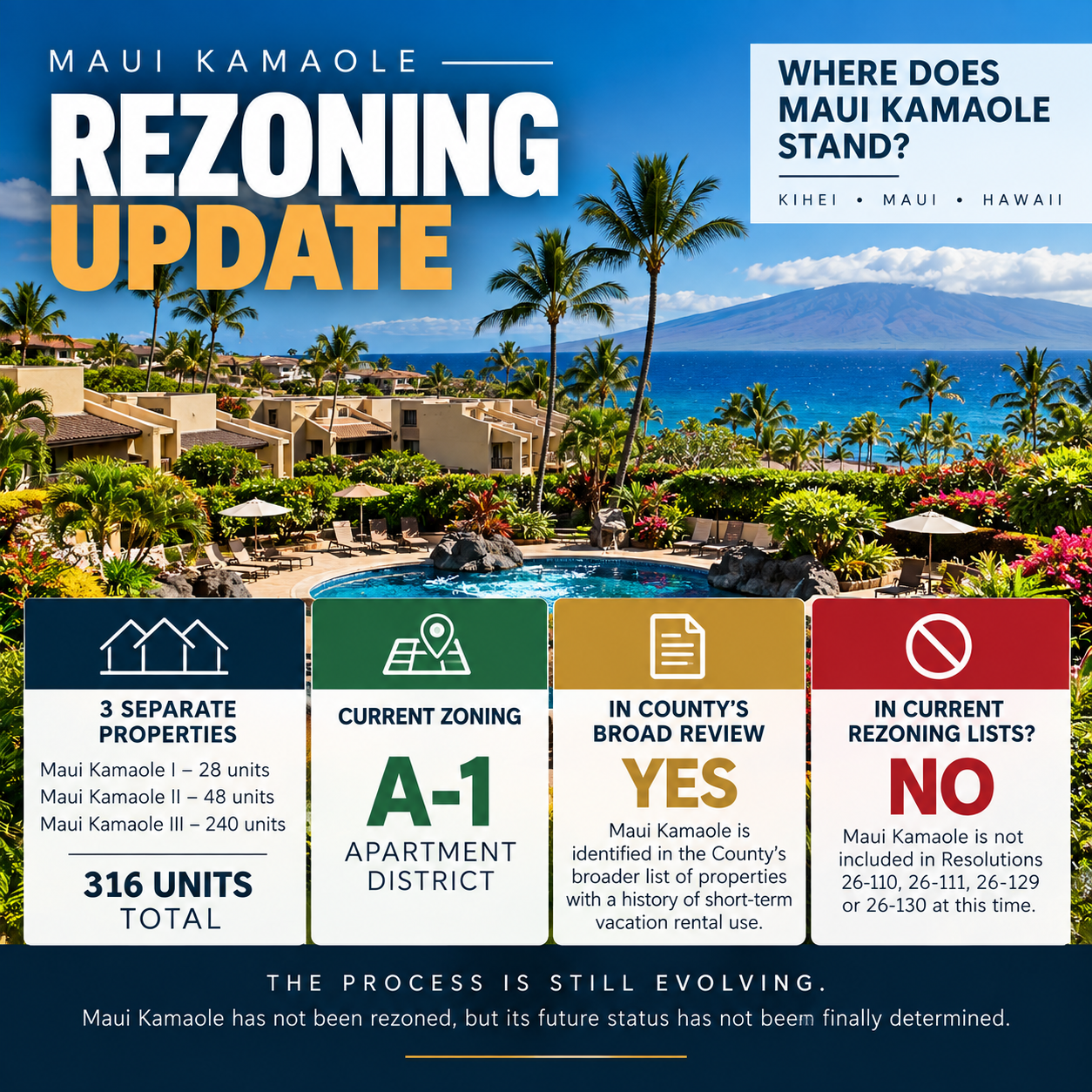
Maui County records identify Maui Kamaole as three separate condominium property entries, all located at 2777 South Kīhei Road:
- Maui Kamaole — 28 units
- Maui Kamaole II — 48 units
- Maui Kamaole III — 240 units
That’s a total of 316 units.
All three are identified as being within the A-1 Apartment District, and all three appear in the County’s broader review of Apartment District properties historically allowed to be used for short-term occupancy.
That distinction is important.
Maui Kamaole is very much part of the larger conversation surrounding Maui’s historically legal vacation-rental condominiums. What it does not currently have is placement into one of the formal H-3/H-4 rezoning pathways now moving through the County.
Why Are Other Complexes Being Considered?
Maui County created the new H-3 and H-4 Hotel Districts as part of its broader effort to address Apartment-zoned properties that have historically operated as vacation rentals.
Rather than treating every condominium property identically, the County has been considering different groups of properties under different resolutions.
For example, Resolution 26-110 addresses certain properties based on circumstances such as timeshare, leasehold and other characteristics. Nearby Maui Hill is included in that process.
Resolution 26-111 provides another pathway for properties identified as operating in a hotel-like manner. Nearby Kamaole Sands is among the properties being considered through that process.
And Resolution 26-129 CD1 created another pathway involving properties meeting certain sea-level-rise, flood-hazard or shoreline criteria.
Maui Kamaole I, II and III are currently not included in those resolutions.
That Makes Maui Kamaole Particularly Interesting
Look at what is happening within this relatively small section of South Kīhei.
Maui Hill has a potential rezoning pathway.
Kamaole Sands has a potential rezoning pathway.
Other Kīhei condominium properties are being considered under the coastal-hazard pathway.
Yet Maui Kamaole — a 316-unit resort condominium community with a long history of vacation-rental use — currently does not have an assigned pathway.
That naturally raises questions.
What criteria will ultimately determine whether Maui Kamaole receives consideration for H-3 Hotel zoning?
Could Maui Kamaole qualify under another resolution?
Could it be added through an amendment?
Could another resolution eventually be introduced for properties that did not fit within these initial categories?
At this point, those questions have not been finally resolved.
Maui Kamaole Has Not Been Ignored
This is an important distinction for owners.
Maui Kamaole appears in the County’s broader work examining Apartment District properties and their historical short-term occupancy. The County documentation specifically identifies Maui Kamaole, Maui Kamaole II and Maui Kamaole III.
So the property isn't unknown to the County or missing from the overall discussion.
What is missing right now is a formal rezoning pathway.
That is very different from saying Maui Kamaole has been permanently excluded from consideration.
The County’s lists have already evolved during this process. Properties have been added, different criteria have been considered, and multiple resolutions have emerged addressing different circumstances.
The process is still moving.
What Does This Mean for Maui Kamaole Owners?
The most important thing is not to overstate where things currently stand in either direction.
- Maui Kamaole has not been rezoned H-3 Hotel.
- Maui Kamaole also is not currently included in the active rezoning resolutions we have been following.
But that does not establish that Maui Kamaole will never receive an H-3 pathway. Any such change would require additional County action. For owners, that makes continued attention to the legislative process extremely important.
What About Buyers?
This is also why purchasing a vacation-rental condominium on Maui now requires more due diligence than simply asking whether a property has historically permitted short-term rentals.
For years, buyers and real estate professionals often asked one primary question:
“Is it on the Minatoya List?”
Today, that question isn't enough.
A buyer should understand the property’s current zoning, its historical short-term rental status, whether it has been identified by the County for potential rezoning, whether it is actually included in a rezoning resolution, and where that resolution currently stands.
Those are separate questions, and the answers can change as legislation progresses.
So Where Does Maui Kamaole Stand Today?
The simplest way to explain it is this:
- Maui Kamaole has historically been recognized as a short-term occupancy property.
- Maui Kamaole I, II and III are currently A-1 Apartment-zoned.
- The property has been identified in the County’s broader review of Apartment District vacation-rental properties.
- It is not currently included in the H-3/H-4 rezoning resolutions discussed above.
- It has not been rezoned H-3 Hotel.
And most importantly, its future zoning status has not been finally determined simply because it isn't on one of the current lists.
For Maui Kamaole owners, buyers and sellers, this is one property I would continue watching closely.
Maui County’s approach to these condominium properties is evolving, and Maui Kamaole’s current absence from a formal rezoning pathway may prove to be an important part of what happens next.